The Radical Act of Seeing: Broaching as a Clinical Necessity 보는 것의 근본적 행위: 임상적 필수 요소로서의 브로칭
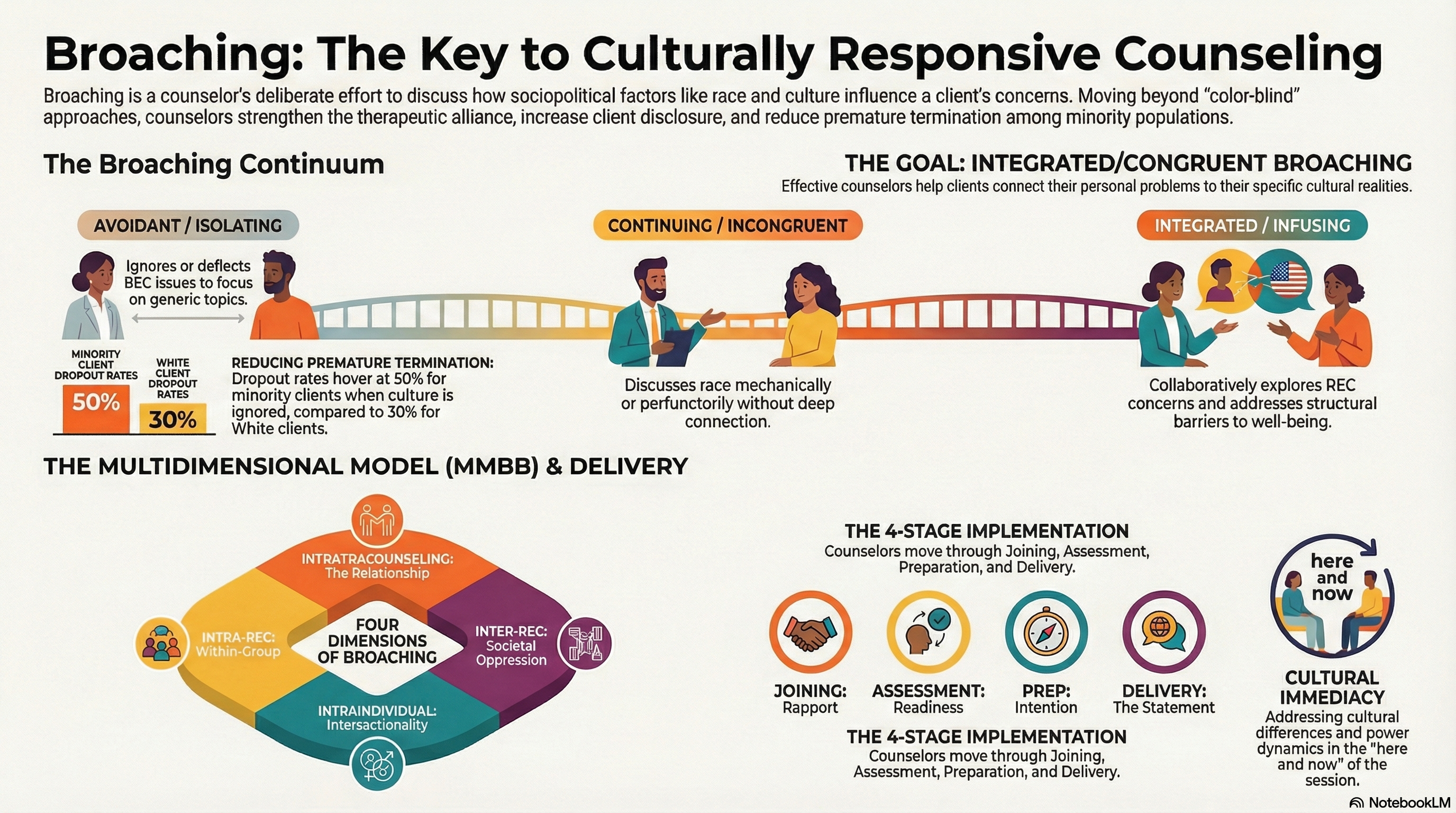
1. The Failure of "Color Blindness" / '색맹(인종 무시)' 방식의 실패
- The Clinical Gap / 임상적 격차: Premature termination rates are 30% for White clients but 50% for culturally diverse clients. / 백인 클라이언트의 조기 상담 종결률은 30%인 반면, 다문화 클라이언트는 50%에 달한다.
- Avoidance vs. Neutrality / 회피 대 중립: Ignoring race is not being neutral; it is an act of avoidance that validates the client's daily experiences of denial. / 인종을 무시하는 것은 중립적인 것이 아니라, 클라이언트가 일상에서 겪는 부정의 경험을 정당화하는 회피 행위이다.
- Cultural Encapsulation / 문화적 캡슐화: A therapist trapped in their own limited worldview effectively gaslights the client’s lived experience. / 자신의 제한된 세계관에 갇힌 상담사는 결과적으로 클라이언트의 실존적 경험을 부정(가스라이팅)하게 된다.
2. The Broaching Continuum: 5 Behaviors / 브로칭 연속체: 5가지 행동
- Avoidant / 회피적: Ignores race entirely, redirecting to "generic" topics. / 인종을 완전히 무시하고 '일반적인' 주제로 대화를 돌림.
- Isolating / 고립적: A perfunctory, "check-box" mention of race that feels hollow. / 인종에 대해 의무적이고 형식적으로 언급하지만 공허하게 느껴짐.
- Continuing-Incongruent / 지속적-불일치: Mechanical and awkward attempts that may create tension. / 기계적이고 어색한 시도로 인해 오히려 긴장이 유발될 수 있음.
- Integrated-Congruent / 통합적-일치: Effectively weaving identity into the presenting problem. / 정체성을 클라이언트의 호소 문제와 효과적으로 엮어냄.
- Infusing / 주입적: The gold standard; consistent focus on social justice and structural barriers. / 최상의 기준; 사회 정의와 구조적 장벽에 지속적으로 초점음 맞춤.
3. Cultural Immediacy & Divesting Status / 문화적 즉시성과 지위 포기
- The "Here and Now" / '여기 그리고 지금': Exploring the relationship between counselor and client in real-time. / 상담사와 클라이언트 간의 관계를 실시간으로 탐색함.
- Divesting Expert Status / 전문가 지위 내려놓기: Admitting limitations and letting the client be the authority of their own experience. / 자신의 한계를 인정하고 클라이언트가 자신의 경험에 대한 권위자가 되도록 하는 것.
- Cultural Catharsis / 문화적 카타르시스: Acknowledging power differentials leads to profound trust and emotional release. / 권력 격차를 인정하는 것은 깊은 신뢰와 정서적 해소로 이어진다.
4. The MMBB Model: Beyond Racism / MMBB 모델: 인종차별 그 너머
- Intra-REC (Intraracial Stratification) / 인종 내 차원: Addressing issues like colorism within a single group. / 동일 집단 내에서의 '색차별(colorism)'과 같은 문제를 다룸.
- Intra-individual (Intersectionality) / 개인 내 차원: Looking at the overlap of age, class, gender, and disability. / 연령, 계층, 성별, 장애의 교차성을 살펴봄.
- Acculturation Stress / 문화적 적응 스트레스: Conflicts arising between traditional expectations and Western autonomy. / 전통적 기대와 서구적 자율성 사이에서 발생하는 갈등을 다룸.
| Domain (영역) | Focus (초점) | Clinical Rationale (임상적 근거) | Sample Broaching Statement (상담 예시 문구) |
| 1. Intra-Counseling (상담 내 차원) |
Counselor-Client Relationship (상담사-클라이언트 관계) |
Addresses the "elephant in the room" regarding visible identity differences to build trust. (신뢰 형성을 위해 가시적인 정체성 차이를 직접 다룸) |
"I notice I am a White male and you are a Woman of Color; I wonder how that might affect your comfort in sharing with me?" ("저는 백인 남성이고 귀하는 유색인종 여성인데, 이것이 저에게 속마음을 이야기하는 데 어떤 영향을 줄까요?") |
| 2. Intra-Individual (개인 내 차원) |
Intersectionality (교차 정체성) |
Recognizes that a client is not just one thing (e.g., just "Black") but a mix of race, gender, class, etc. (인종, 성별, 계층 등 중첩된 정체성의 복합적 경험을 인정함) |
"As a gay Latinx man, how do these different parts of who you are influence the way you navigate your workplace?" ("라틴계 게이 남성으로서, 귀하의 이러한 여러 정체성이 직장 생활을 하는 방식에 어떤 영향을 미치나요?") |
| 3. Intra-REC (REC 내 차원) |
Within-Group Diversity (집단 내 다양성) |
Prevents "stereotyping" by acknowledging differences in acculturation, skin tone, or generation within a group. (집단 내 문화 적응, 피부색, 세대 차이를 인정하여 고정관념을 방지함) |
"Even though you and your parents are both Korean, it sounds like your 'American' values on autonomy are clashing with their expectations." ("부모님과 귀하 모두 한국인이지만, 귀하의 자율성 가치와 부모님의 기대가 충돌하고 있는 것처럼 들리네요.") |
| 4. Inter-REC (REC 간 차원) |
Systemic/External Factors (체계적/외부적 요인) |
Validates the client's reality regarding racism, microaggressions, and sociopolitical stress. (인종차별, 미세공격 등 클라이언트가 겪는 사회적 스트레스와 현실을 확인해줌) |
"With everything happening in the news regarding racial injustice, I want to create space for how that might be adding to your anxiety today." ("최근 인종 불평등 관련 뉴스들을 보며, 그것이 오늘 귀하의 불안감을 어떻게 가중시키고 있는지 이야기해보고 싶습니다.") |
5. Structural Competency / 구조적 역량
- Beyond the Dyad / 개인 관계를 넘어서: Identifying institutional forces (e.g., biased disciplinary data) that stifle well-being. / 웰빙을 저해하는 제도적 힘(예: 편향된 징계 데이터)을 식별함.
- Malfeasance of Silence / 침묵의 위법 행위: Failing to address cultural concerns is a violation of ethical responsibility. / 문화적 관심을 다루지 않는 것은 윤리적 책임에 반하는 행위이다.
- Active Advocacy / 적극적 옹호: Moving from "coping" to disrupting structural barriers through audits and policy petitions. /순응하는 것을 넘어 감동적인 정책 청원이나 감사를 통해 구조적 장벽을 무너뜨리는 것.
Conclusion: Beyond the Office Walls / 결론: 상담실 벽을 넘어서 Broaching is an invitation to intimacy that requires the counselor to be as vulnerable as the client. It is the bridge to liberation. / 브로칭은 상담사에게도 클라이언트만큼의 취약성을 요구하는 친밀함으로의 초대이다. 이는 해방으로 가는 가교이다.
The Social GGRRAAACCEEESSS (Burnham, 2012) is a framework used in therapy and social work to help practitioners recognize the different visible and invisible "layers" of identity and power that affect a person's life.
It is an acronym that stands for the following:
Social GGRRAAACCEEESSS / 사회적 GGRRAAACCEEESSS
- Gender / 성별: Being male, female, non-binary, or trans. / 남성, 여성, 논바이너리 또는 트랜스젠더.
- Gender Identity / 성 정체성: One's internal sense of their own gender. / 자신의 성별에 대한 내적 인식.
- Geography / 지리: Where someone lives or comes from (urban vs. rural). / 거주지 또는 출신지 (도시 vs 시골).
- Race / 인종: Physical characteristics and social categories. / 신체적 특성 및 사회적 분류.
- Religion / 종교: Faith, beliefs, and spiritual practices. / 신앙, 신념 및 영적 실천.
- Age / 연령: Life stage and generational identity. / 생애 단계 및 세대적 정체성.
- Ability / 능력: Physical or mental disabilities or giftedness. / 신체적 또는 정신적 장애, 혹은 영재성.
- Appearance / 외모: How one is perceived physically (weight, height, clothes). / 신체적으로 어떻게 인식되는가 (체중, 키, 의복 등).
- Class / 계급: Economic status, education, and social standing. / 경제적 상태, 교육 및 사회적 지위.
- Culture / 문화: Shared traditions, languages, and values. / 공유된 전통, 언어 및 가치관.
- Ethnicity / 민족: Ancestry and cultural heritage. / 가계 및 문화적 유산.
- Education / 교육: Level of formal schooling and academic background. / 정규 교육 수준 및 학력 배경.
- Employment / 고용: Job status, career path, or unemployment. / 직업 상태, 경력 경로 또는 실업 상태.
- Sexuality / 성적 지향: Who one is attracted to (heterosexual, gay, etc.). / 누구에게 끌리는가 (이성애자, 동성애자 등).
- Sexual Orientation / 성적 지향성: The pattern of emotional and sexual attraction. / 정서적 및 성적 끌림의 패턴.
- Spirituality / 영성: Personal sense of meaning or connection. / 의미나 연결에 대한 개인적인 감각.
Why it matters / 이것이 중요한 이유
- Intersectionality / 교차성: It reminds us that no one is defined by just one thing. For example, a young Black woman’s experience is shaped by the intersection of Age, Race, and Gender. / 누구도 단 한 가지 요소로만 정의되지 않음을 상기시켜 줍니다. 예를 들어, 젊은 흑인 여성의 경험은 연령, 인종, 성별의 교차점에서 형성됩니다.
- Power and Privilege / 권력과 특권: In any given situation, some of these "Graces" are more visible and carry more social power than others. / 어떤 상황에서든 이러한 'Graces' 중 일부는 다른 것보다 더 잘 보이며 더 큰 사회적 권력을 가집니다.
- Self-Reflexivity / 자기 성찰: Practitioners use this tool to see their own biases and understand how their own "Graces" might differ from their clients'. / 실무자들은 이 도구를 사용하여 자신의 편견을 확인하고, 자신의 'Graces'가 클라이언트의 것과 어떻게 다를 수 있는지 이해합니다.