Love: The Ultimate Clinical Competency
사랑: 궁극의 임상적 역량
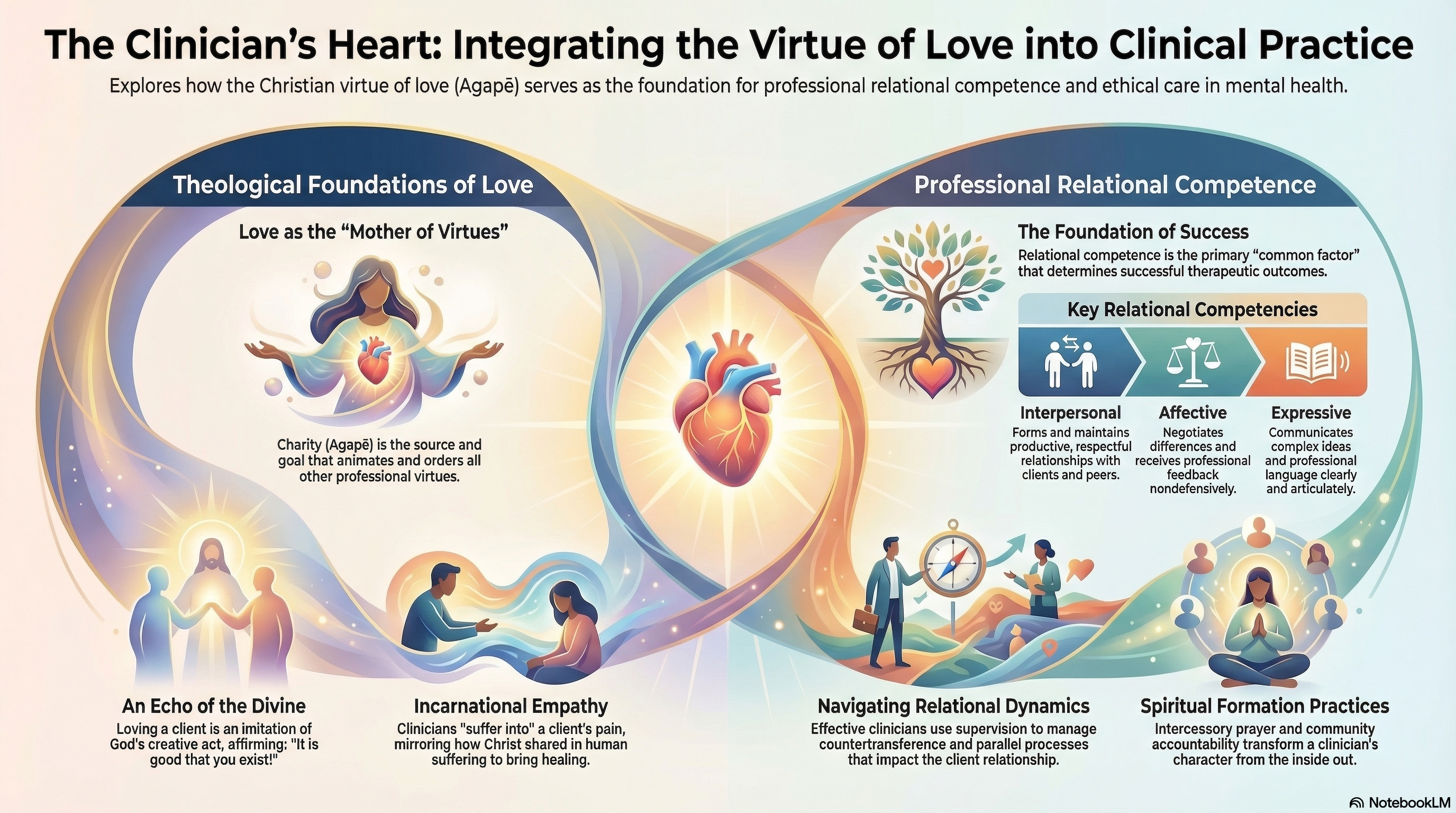
A high-skill clinician without heart is a "clanging cymbal"—a jarring noise. To move from a technician to a healer, one must recognize love not as a vague emotion, but as a measurable relational competence that animates every clinical skill.
심장은 없고 기술만 뛰어난 임상가는 '울리는 꽹과리'와 같아 불협화음을 냅니다. 기술자에서 치유자로 거듭나기 위해서는 사랑을 막연한 감정이 아니라, 모든 임상적 기술에 생명력을 불어넣는 측정 가능한 관계적 역량으로 인식해야 합니다.
1. Love as Relational Competence
관계적 역량으로서의 사랑
Love in the therapy room is operationalized as Relational Competence. Research shows that "common factors"—the qualities of the therapeutic alliance—impact success more than specific techniques.
상담실에서의 사랑은 관계적 역량으로 구체화됩니다. 연구에 따르면 '공통 요인', 즉 치료적 동맹의 질이 특정 기법보다 치료의 성공에 더 큰 영향을 미칩니다.
- Interpersonal (대인관계): Forming alliances across diverse backgrounds. (다양한 배경을 가진 이들과 연맹을 형성하는 능력.)
- Affective (정서적): Negotiating conflict and receiving feedback non-defensively. (갈등을 협상하고 방어적이지 않게 피드백을 수용하는 능력.)
2. The Power of "It is Good That You Exist"
"당신이 존재함은 선한 일입니다"의 급진적 힘
The most profound act a clinician performs is to offer an "echo" of God’s creative "Yes." To love a client is to look past the diagnostic label and say, "It is good that you exist." This creates an incandescence of presence that facilitates healing.
임상가가 행하는 가장 심오한 행위는 하나님의 창조적인 '예'라는 선언에 메아리치는 것입니다. 내담자를 사랑한다는 것은 진단명 뒤에 숨겨진 그 사람을 바라보며 "당신이 존재한다는 것은 참으로 선한 일입니다"라고 말해주는 것입니다. 이는 치유를 돕는 강력한 존재의 광휘를 만들어냅니다.
3. Empathy as "Incarnational" Presence
'성육신적' 임재로서의 공감
True empathy is "Incarnational"—God becoming one of us to share in suffering. It is a "suffering into" the client's pain. Clinicians must resist "exits" like generalizing or shifting focus to their own stories, staying instead at the "bottom floor" of the suffering.
진정한 공감은 하나님이 우리 중 하나가 되어 고통을 나누셨던 '성육신적' 성격을 띱니다. 이는 내담자의 고통 속으로 함께 '침잠'하는 것입니다. 임상가는 일반화하거나 자신의 이야기로 화제를 돌리는 '회피로'를 경계하고, 고통의 '가장 낮은 곳'에 머물러야 합니다.
4. The Four Pillars of Trinitarian Love
삼위일체 사랑의 네 기둥
The Balswick Model provides a blueprint for restorative care, moving away from paternalism toward a community of growth.
**볼즈윅 모델(Balswick Model)**은 온정적 간섭주의에서 벗어나 성장을 위한 공동체로 나아가는 회복적 돌봄의 청사진을 제공합니다.
| Pillar (기둥) | Definition (정의) | Clinical Application (임상적 적용) |
| Covenant Love | Unconditional security. | Safety not dependent on client "success." |
| 언약적 사랑 | 무조건적인 안전. | 내담자의 '성공' 여부에 의존하지 않는 안전함. |
| Gracing Love | Forgiveness over judgment. | Handling errors (client and clinician) with grace. |
| 은혜의 사랑 | 심판보다 용서. | 내담자와 임상가의 실수를 은혜로 다룸. |
| Empowering Love | Power used to serve. | Using the office's power differential to foster growth. |
| 권능의 사랑 | 섬김을 위한 권력. | 상담실의 권력 격차를 성장을 돕는 데 사용. |
| Intimate Love | Differentiated unity. | Authentic connection while maintaining boundaries. |
| 친밀한 사랑 | 차별화된 일치. | 경계를 유지하면서 진정성 있게 연결됨. |
5. Intercessory Prayer for Countertransference
역전이를 위한 중보기도
Clinical work triggers Countertransference (biases, boredom, attraction). Intercessory prayer acts as a "purifying bath," transforming a "strange and intolerable" patient into a person of inestimable worth, allowing the clinician to love beyond their natural capacity.
임상 작업은 역전이(편견, 지루함, 끌림)를 유발합니다. 중보기도는 '정화의 목욕' 역할을 하여 '낯설고 견디기 힘든' 환자를 헤아릴 수 없는 가치를 지닌 인격체로 변화시키며, 임상가가 자신의 타고난 한계를 넘어 사랑할 수 있게 합니다.
Deep Dive: Common Factors vs. Specific Techniques
심층 탐구: 공통 요인 대 특정 기법
The debate between the "Technician" and the "Healer" is supported by data regarding what actually causes change in therapy.
'기술자'와 '치유자' 사이의 논쟁은 실제로 치료 현장에서 무엇이 변화를 일으키는지에 대한 데이터에 근거합니다.
| Factor (요인) | Contribution to Outcome (결과 기여도) | Clinical Focus (임상적 초점) |
| Extra-therapeutic Factors | 40% | The client’s life, environment, and strengths. |
| 치료 외적 요인 | 내담자의 삶, 환경 및 강점. | |
| Therapeutic Alliance | 30% | Empathy, warmth, and "Common Factors" (Love). |
| 치료적 동맹 | 공감, 온정 및 '공통 요인'(사랑). | |
| Expectancy / Hope | 15% | The client's belief in the process. |
| 기대 및 희망 | 과정에 대한 내담자의 믿음. | |
| Techniques / Models | 15% | Specific interventions (CBT, EMDR, etc.). |
| 기법 및 모델 | 구체적인 개입 (CBT, EMDR 등). |
- The School of Charity: Clinical excellence requires a character change. It is not just about what we do, but who we become in the presence of the sufferer.
- The Ethical Ceiling: True healing happens at the ceiling of agapē, where we silence our self-interest to make room for the client's imago Dei.
- 자선 학교: 임상적 탁월함은 인격의 변화를 요구합니다. 이는 우리가 무엇을 하느냐의 문제가 아니라, 고통받는 자 앞에서 우리가 어떤 사람이 되느냐의 문제입니다.
- 윤리적 천장: 진정한 치유는 *아가페(agapē)*의 천장에서 일어납니다. 그곳에서 우리는 자신의 이익을 내려놓고 내담자의 '하나님의 형상(imago Dei)'을 위한 자리를 만듭니다.