Why “Calm Down” is a Power Move: 5 Revelations About Tone Policing
“진정해”가 권력 행사인 이유: 말투 지적에 관한 5가지 사실
1. Introduction: The Civility Trap / 서론: ‘정중함’이라는 함정
You are in the heat of a high-stakes conversation about systemic injustice... Suddenly, your interlocutor holds up a hand... “I’m happy to discuss this rationally,” they say, “but I’m not going to listen if you’re going to yell.” In an instant, the conversation about the actual harm vanishes. The focus is violently jerked away from the problem and onto your volume, your word choice, and your emotional state. This is the "civility trap."
당신은 체제적 불평등에 관한 중대한 대화의 한복판에 있습니다... 갑자기 상대방이 손을 들어 대화를 끊습니다... “이성적으로 토론할 용의는 있지만, 소리를 지른다면 듣지 않겠습니다.”라고 그들은 말합니다. 순식간에 실제 피해에 대한 대화는 사라집니다. 초점은 문제의 본질에서 당신의 목소리 크기, 단어 선택, 그리고 감정 상태로 거칠게 옮겨갑니다. 이것이 바로 ‘정중함의 함정’입니다.
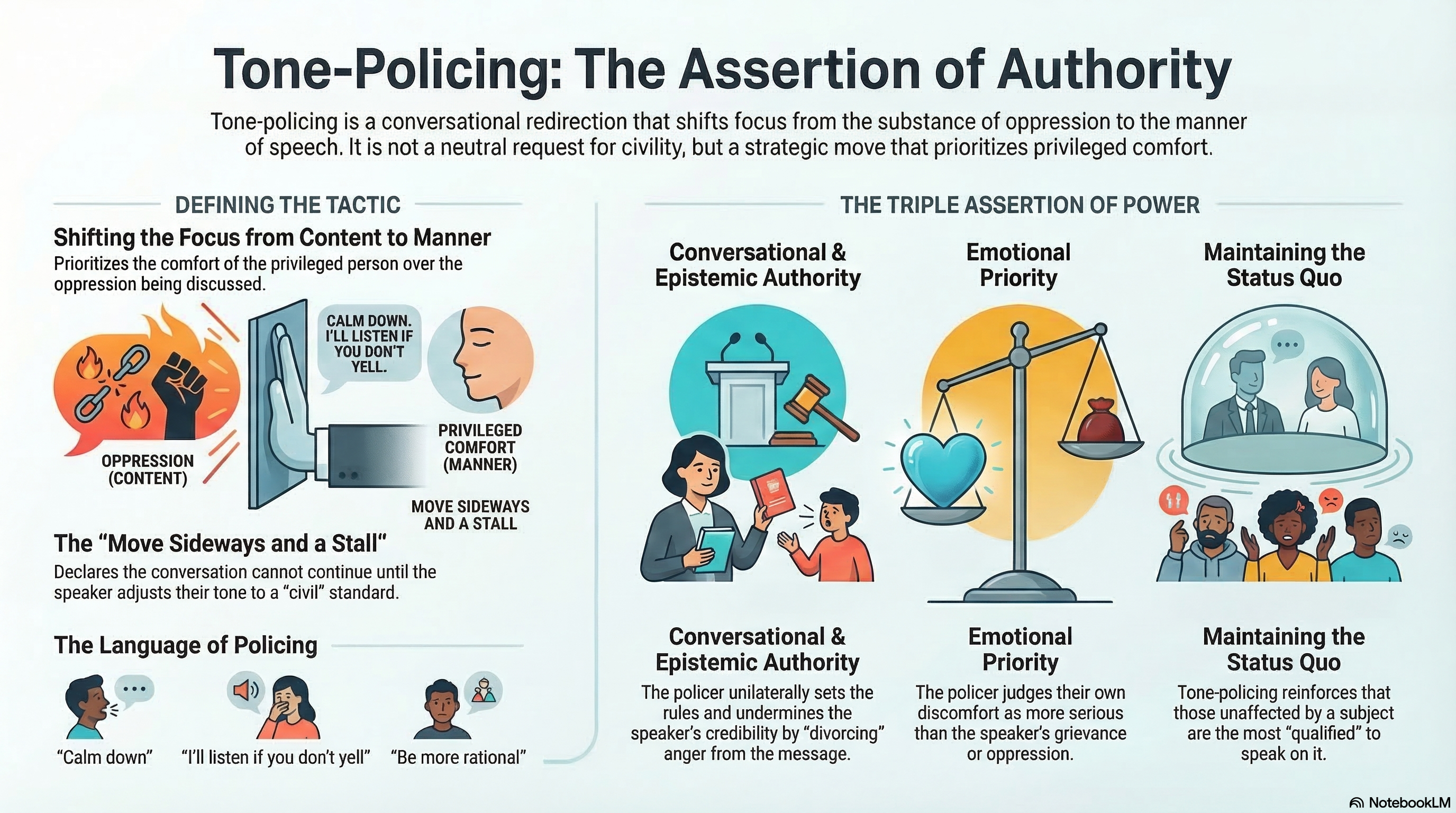
2. It’s Not an Intervention, It’s a “Move Sideways and a Stall” / 개입이 아닌, “옆으로 비껴가기와 시간 끌기”
The Move Sideways: The policer shifts the focus from the content of the conversation (the "what") to the manner of the discussion (the "how"). The Stall: Unlike a helpful suggestion, tone policing insists that the conversation cannot and will not continue until the tone is adjusted.
옆으로 비껴가기: 말투 지적을 하는 사람은 대화의 내용(‘무엇’)에서 대화의 방식(‘어떻게’)으로 초점을 전환합니다. 시간 끌기: 도움이 되는 제안과 달리, 말투 지적은 상대의 태도가 교정될 때까지 대화가 계속될 수 없으며 계속하지 않겠다는 태도를 고수합니다.
3. The Three Hidden Claims to Authority / 권위에 대한 세 가지 숨겨진 주장
- Conversational Authority (대화의 권위): The policer appoints themselves the sole legislator of conversational rules. (지적하는 사람은 자신을 대화 규칙의 유일한 입법자로 임명합니다.)
- Epistemic Authority (인식적 권위): This claim suggests a message is only valid if delivered with "disinterested impartiality." (이 주장은 메시지가 ‘냉정한 공정함’으로 전달될 때만 유효하다고 암시합니다.)
- Emotional Authority (감정적 권위): The policer decides that their own disapproval or discomfort is more serious than the speaker’s grievance. (지적하는 사람은 자신의 불편함이 화자의 고통보다 더 심각한 문제라고 결정합니다.)
4. The “Anger-Silencing Spiral” / “분노-침묵의 나선”
Demanding that a speaker remain "dispassionate" creates what scholar Alison Bailey calls an "anger-silencing spiral." It is a trap that grants the upper hand to those least impacted by the harm being discussed.
화자에게 ‘냉정함’을 유지하라고 요구하는 것은 학자 앨리슨 베일리가 말하는 ‘분노-침묵의 나선’을 만듭니다. 이는 논의 중인 피해로부터 가장 적게 영향받는 이들에게 유리한 고지를 점하게 하는 함정입니다.
5. Distinguishing Tone-Policing from Contextual Feedback / 말투 지적과 맥락적 피드백의 구분
Valid interventions appeal to a shared context or the goal of helping another. Tone policing, however, is a "self-standing authority." It offers no justification beyond the policer’s subjectivity and personal discomfort.
정당한 개입은 공유된 맥락이나 타인을 돕기 위한 목표에 호소합니다. 반면, 말투 지적은 그 자체로 ‘독립적인 권위’로 작용합니다. 이는 지적하는 사람의 주관성과 개인적인 불편함 외에는 아무런 근거를 제시하지 않습니다.
6. The Status Quo: Policing as a Tool of Creation / 현상 유지: 창조의 도구로서의 말투 지적
Tone policing ensures that those most visceral and heavy realities are silenced because their "delivery" makes the comfortable feel uneasy. It reinforces the idea that the only people who ought to be speaking are those unaffected enough to remain calm.
말투 지적은 처절하고 무거운 현실들이 침묵하게 만듭니다. 그 ‘전달 방식’이 기득권층을 불편하게 만들기 때문입니다. 이는 평정심을 유지할 수 있을 정도로 문제의 영향을 받지 않는 사람들만이 발언권을 가져야 한다는 생각을 강화합니다.
7. Conclusion: Toward a More Productive Rage / 결론: 더 생산적인 분노를 향하여
Is it their manner that is the problem, or is it the threat of a message that might change your life? We must choose to move from being referees of tone to being listeners of substance.
문제가 정말 그들의 말투입니까, 아니면 당신의 삶을 바꿀지도 모르는 메시지의 위협입니까? 우리는 말투의 심판이 아닌 본질의 경청자가 되기를 선택해야 합니다.