Beyond the Headlines: 6 Surprising Insights That Redefine How We Think About Race and Law
헤드라인을 넘어: 인종과 법에 대한 생각을 재정의하는 6가지 놀라운 인사이트
Consider the routine interactions that fill an ordinary day. A child repeatedly raises her hand in a fourth-grade classroom, but the teacher repeatedly passes her over. A shopper hands a cashier cash, and the clerk deposits the change without a smile or small talk. A woman steps onto a new-car lot where salespeople cluster in the distance and ignore her, only for her to discover later that she was charged a thousand dollars more than the average white male buyer.
평범한 하루를 채우는 일상적인 상호작용을 떠올려 보십시오. 초등학교 4학년 교실에서 한 아이가 몇 번이고 손을 들지만, 교사는 번번이 아이를 지나쳐 다른 학생을 지목합니다. 한 손님이 계산원에게 현금을 내밀자, 점원은 미소나 가벼운 인사도 없이 거스름돈을 밀어 넣습니다. 한 여성이 신차 매장에 들어서지만 먼발치에 모여 있는 영업사원들은 그녀를 무시하고, 훗날 그녀는 자신이 백인 남성 구매자의 평균 가격보다 1,000달러나 더 많은 돈을 지불했다는 사실을 알게 됩니다.
When these dispiriting transactions occur, their meaning often depends entirely on who is involved. For a white person, an uncomfortable encounter is easily dismissed as an isolated moment of rudeness or someone having a bad day. For a person of color, however, these moments frequently register as microaggressions—small, daily acts of racism that well up from deep-seated cultural assumptions and filter directly into our public civic institutions.
이처럼 낙담스러운 상호작용이 일어날 때, 그 의미는 종종 누구에게 일어난 일인가에 따라 완전히 달라집니다. 백인에게 무례하거나 불쾌한 경험은 단순히 운이 없었거나 상대방이 기분 나쁜 하루를 보내는 중이라고 쉽게 치부될 수 있습니다. 그러나 유색인종에게 이러한 순간들은 깊이 뿌리박힌 문화적 편견에서 비롯되어 공공 시민 제도에 직접 스며드는 일상 속 미세한 인종차별 행위, 즉 '마이크로어그레션(microaggressions)'으로 다가오는 경우가 많습니다.
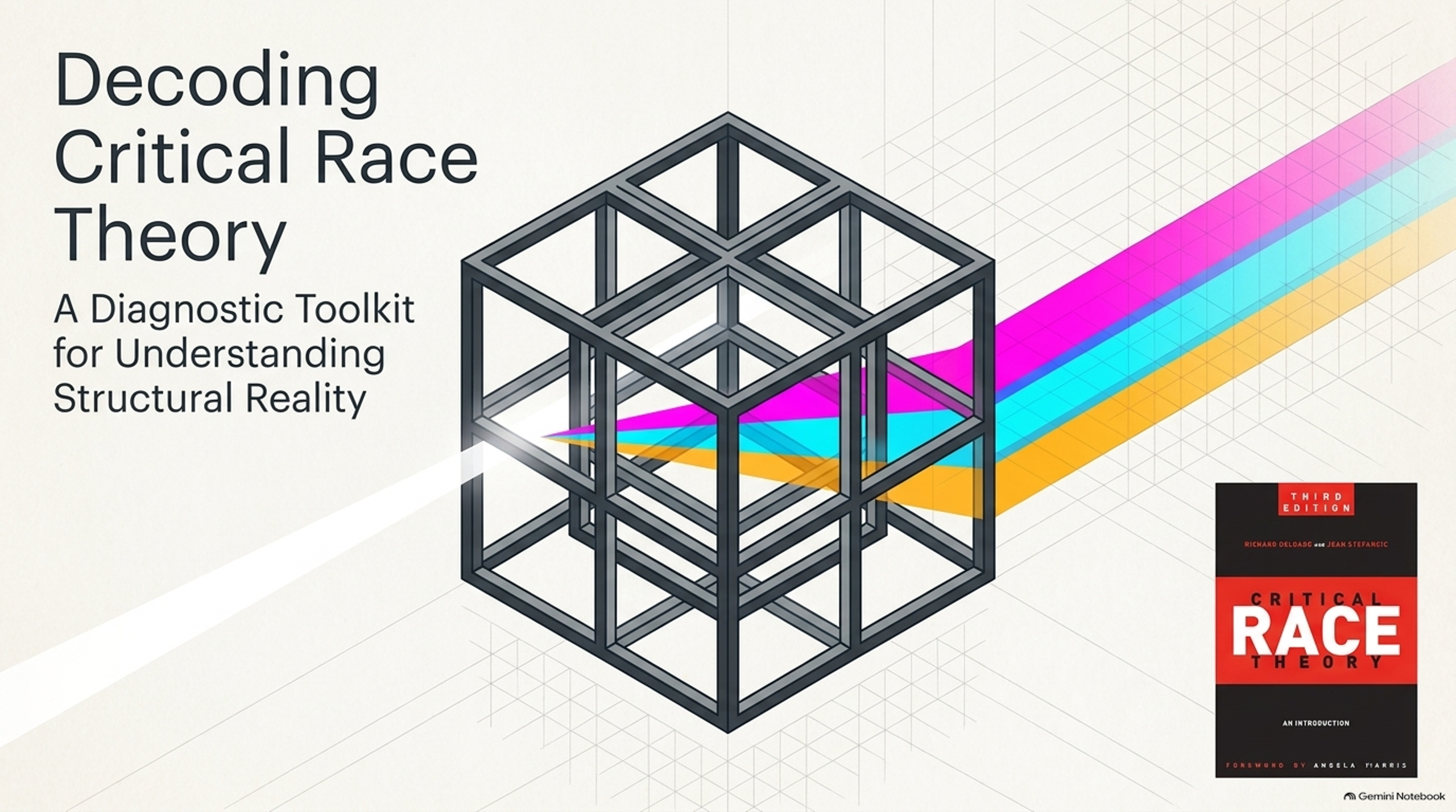
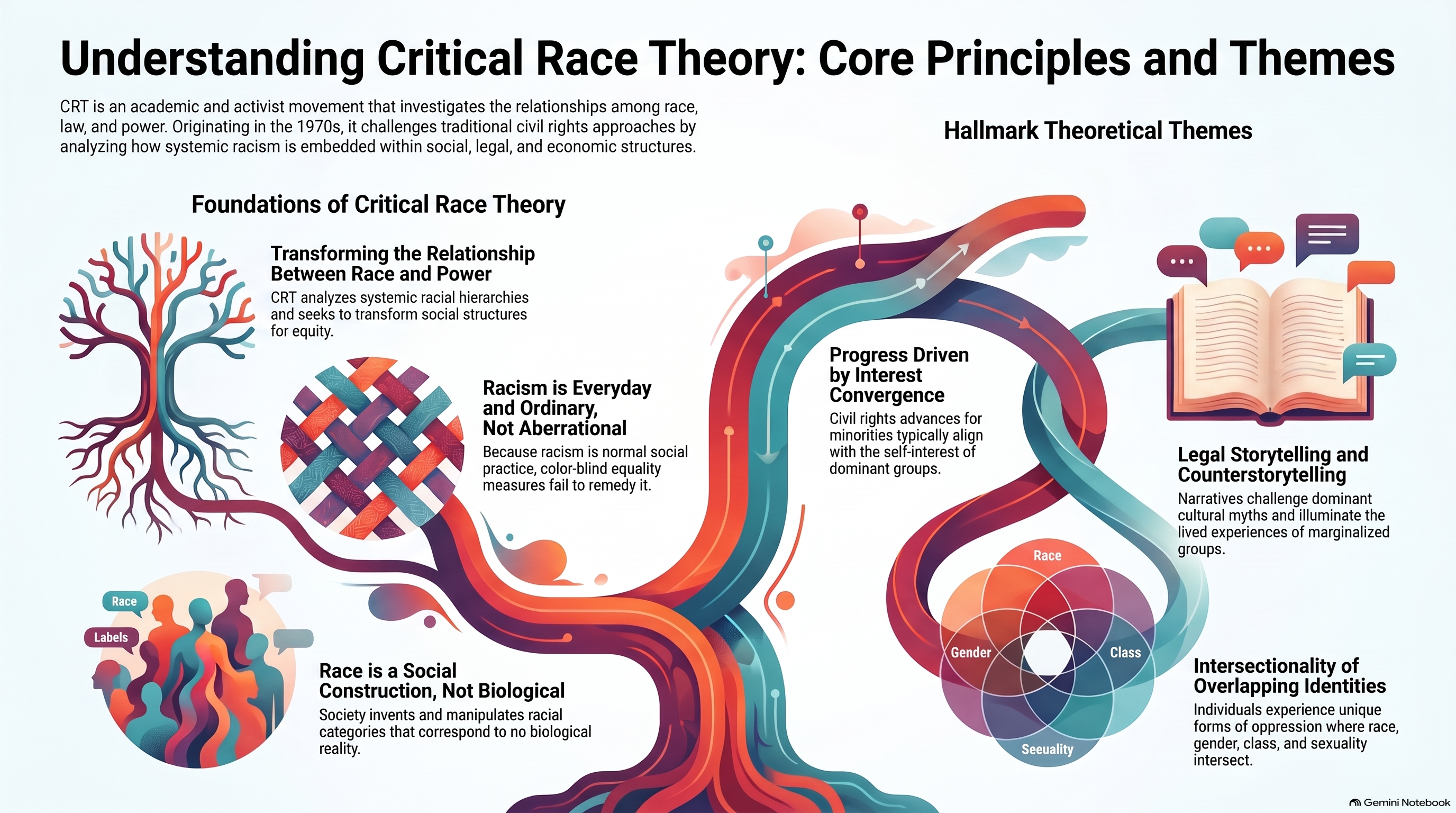
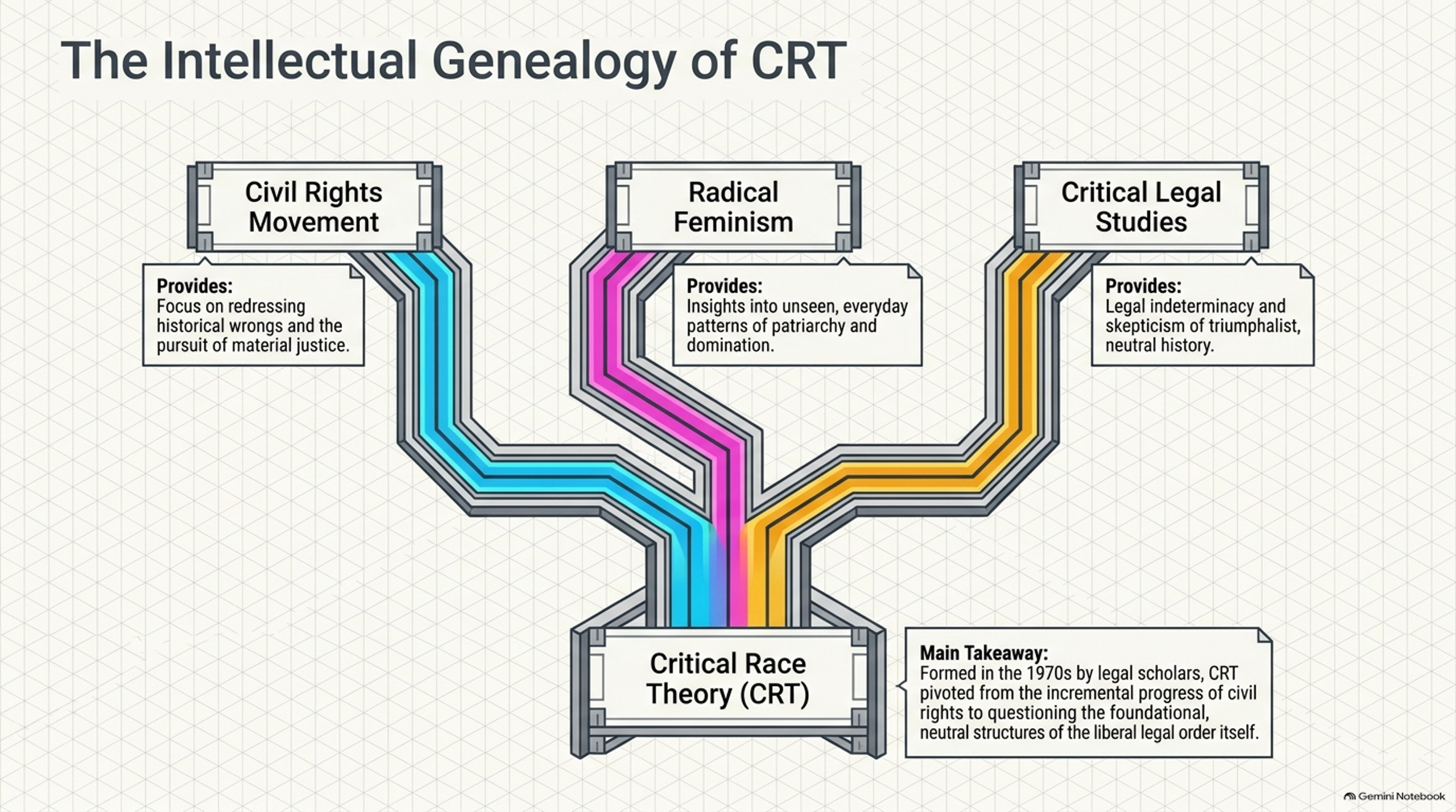
To understand why these patterns persist long after the passage of landmark civil rights legislation, legal scholars in the 1970s and 1980s developed Critical Race Theory (CRT). Pioneered by thinkers like Derrick Bell, Alan Freeman, and Richard Delgado, CRT functions as an analytical framework designed to examine why civil rights progress stalled. By questioning the baseline of the liberal legal order, this framework offers six counterintuitive insights that fundamentally redefine how we view race, power, and justice.
획기적인 민권법이 통과된 지 한참이 지난 후에도 왜 이러한 패턴이 지속되는지 이해하기 위해, 1970년대와 1980년대 법학자들은 '비판적 인종 이론(Critical Race Theory, CRT)'을 발전시켰습니다. 데릭 벨(Derrick Bell), 앨런 프리먼(Alan Freeman), 리차드 델가도(Richard Delgado) 같은 사상가들이 선구적으로 제시한 CRT는 왜 민권의 진보가 정체되었는지를 분석하는 프레임워크입니다. 자유주의 법 질서의 기본 전제에 의문을 제기함으로써, 이 이론은 우리가 인종, 권력, 그리고 정의를 바라보는 시각을 근본적으로 재정의하는 6가지 역발상 인사이트를 제공합니다.
Takeaway 1: Racism Isn't an Exception—It Is "Normal Science"
핵심 인사이트 1: 인종차별은 예외가 아니라 '일상적 표준'이다
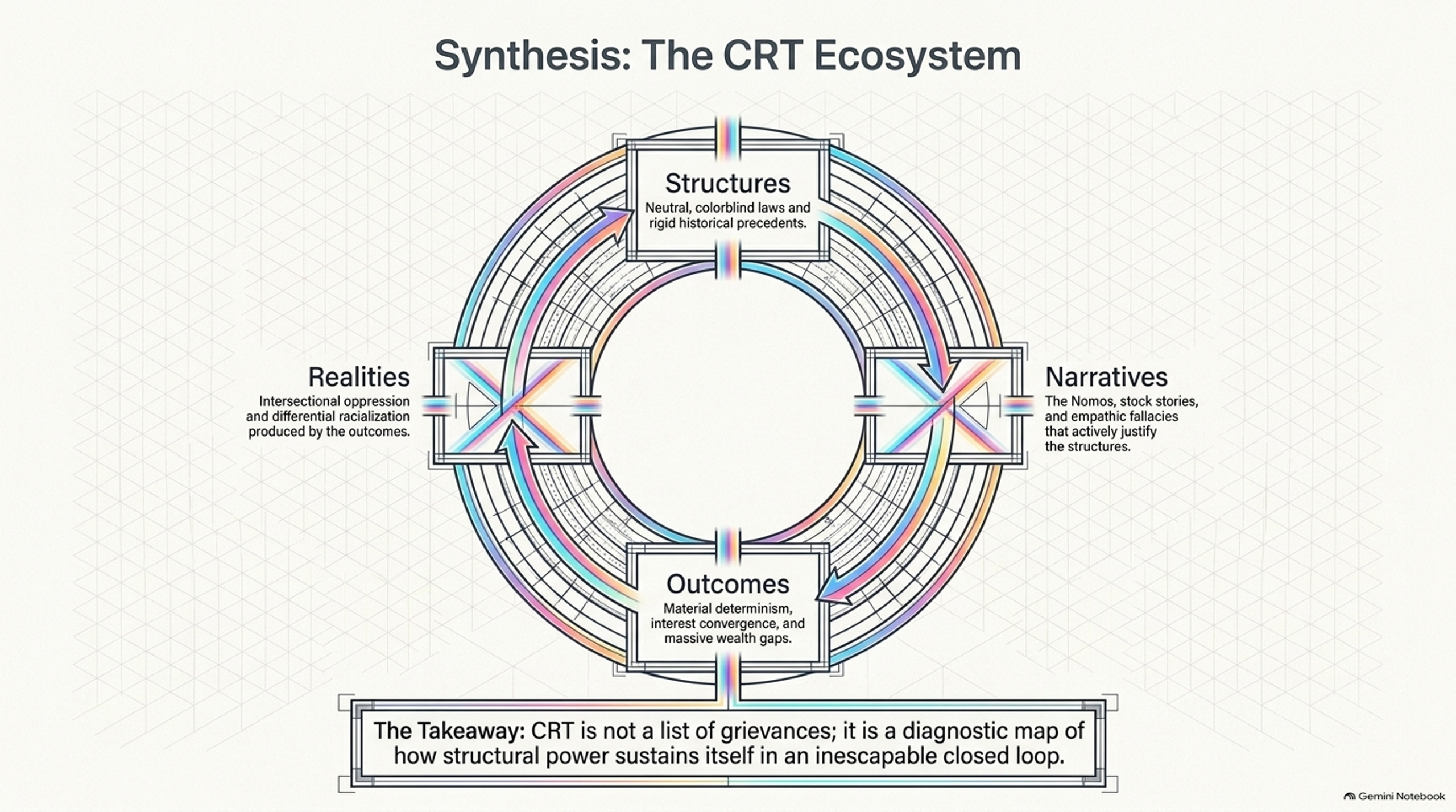
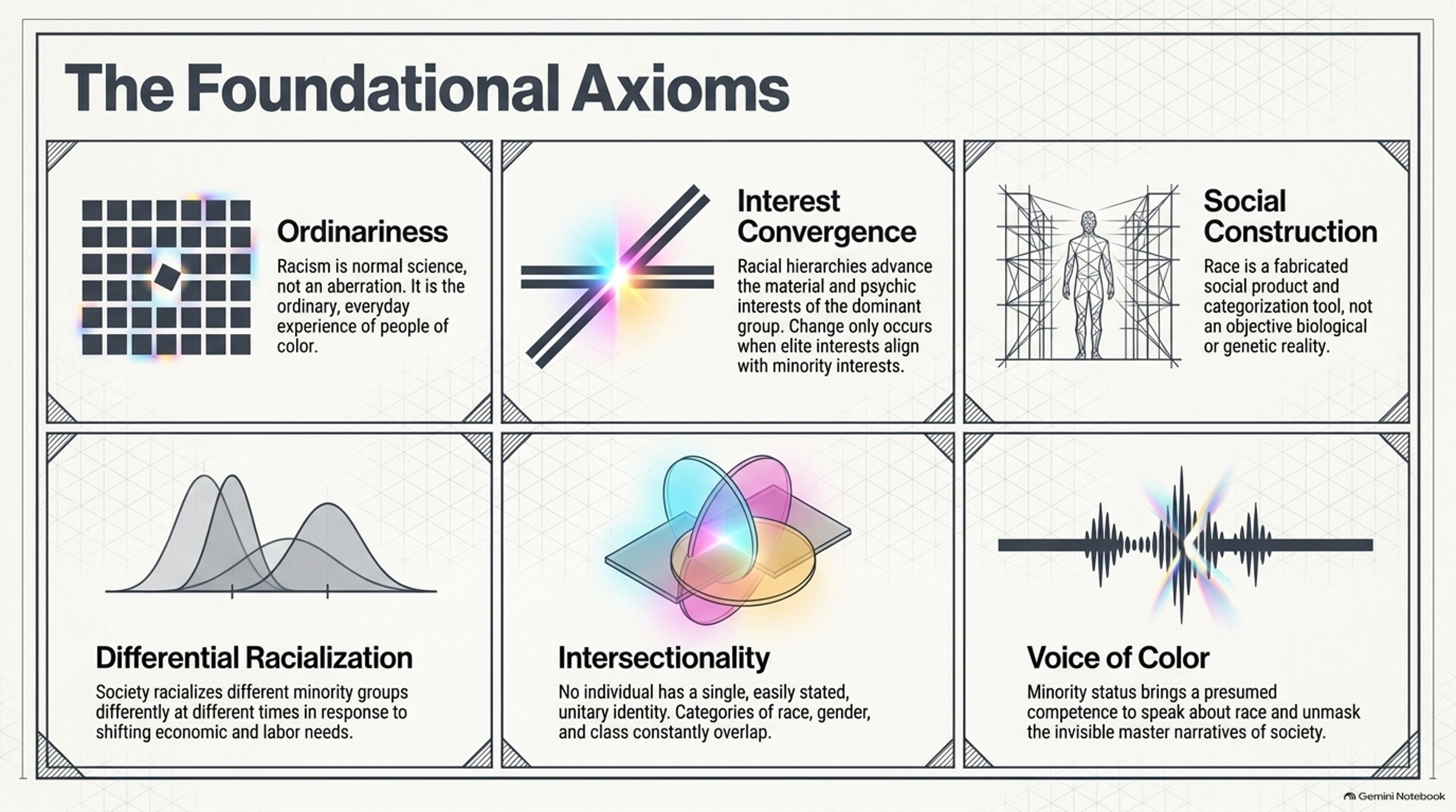
Critical Race Theory posits that racism is not an occasional, aberrational outburst of individual malice. Instead, it functions as "normal science"—the standard, everyday way that society conducts its business. Because racial subordination is so deeply embedded in routine institutional habits, it often remains entirely invisible to the dominant culture.
비판적 인종 이론은 인종차별이 개인의 일시적이거나 악의적인 일탈 행위가 아니라고 주장합니다. 오히려 그것은 사회가 운영되는 표준적이고 일상적인 방식인 '일상적 표준(Normal Science)'으로 기능합니다. 인종적 종속은 제도화된 습관에 깊이 들어앉아 있기 때문에 지배 문화의 눈에는 종종 완전히 invisible(보이지 않는) 상태로 남게 됩니다.
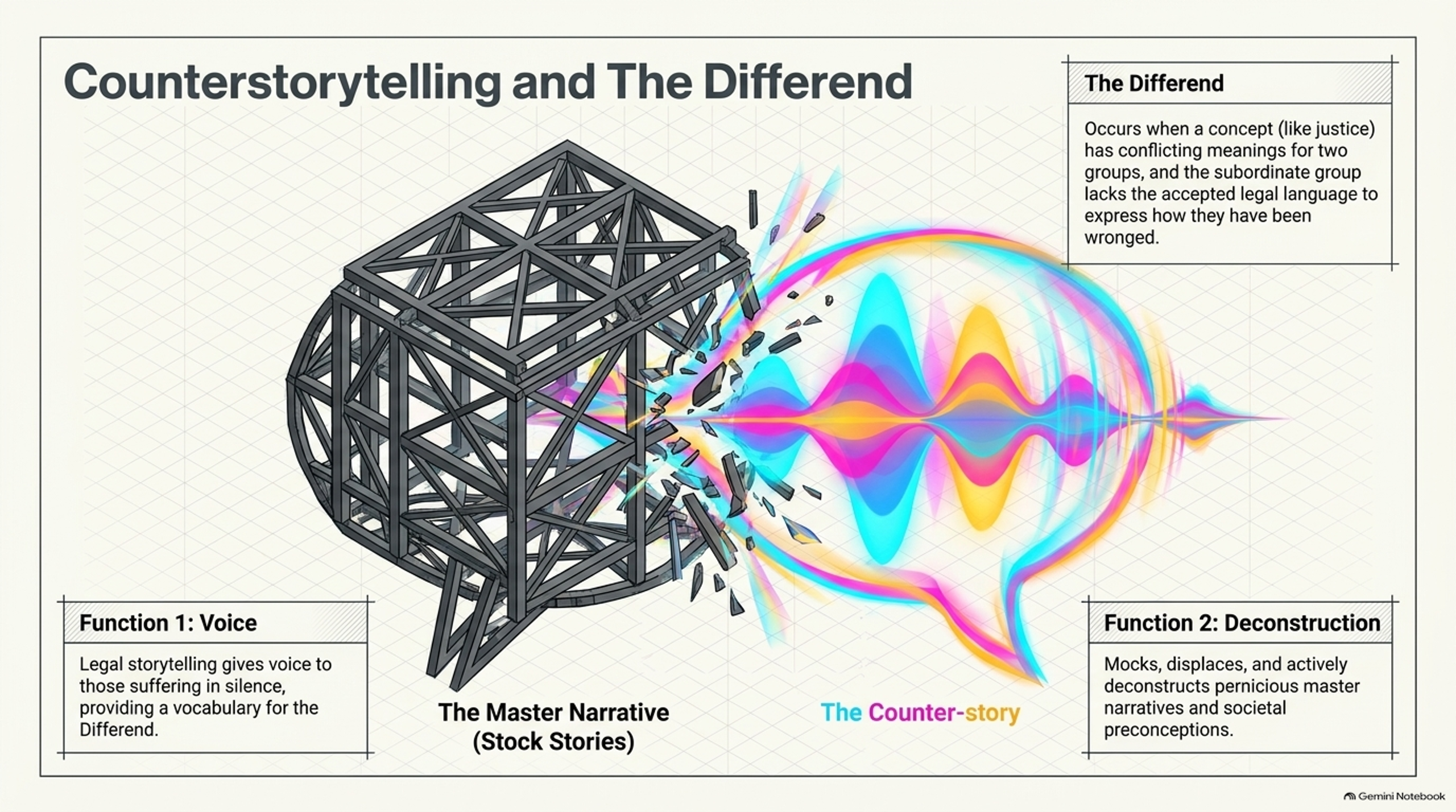
This system of racial hierarchy persists because it serves dual functions for the dominant culture. As CRT scholars emphasize, white-over-color ascendancy yields tangible material benefits for white elites while simultaneously providing a crucial "psychic wage"—a status yield—for working-class whites. Because large segments of society receive concrete advantages from this arrangement, there is little dominant incentive to eradicate it.
이러한 인종적 계층 시스템이 지속되는 이유는 지배 문화에 이중적인 이득을 제공하기 때문입니다. CRT 학자들이 강조하듯, 백인 주도 계층 구조는 백인 엘리트층에게는 유형의 물질적 이익을, 노동자 계급 백인에게는 핵심적인 '심리적 임금(psychic wage)', 즉 신분상의 만족감을 제공합니다. 사회의 상당 부분이 이 구조로부터 구체적인 이득을 얻기 때문에, 이를 뿌리뽑고자 하는 지배적 유인은 거의 존재하지 않습니다.
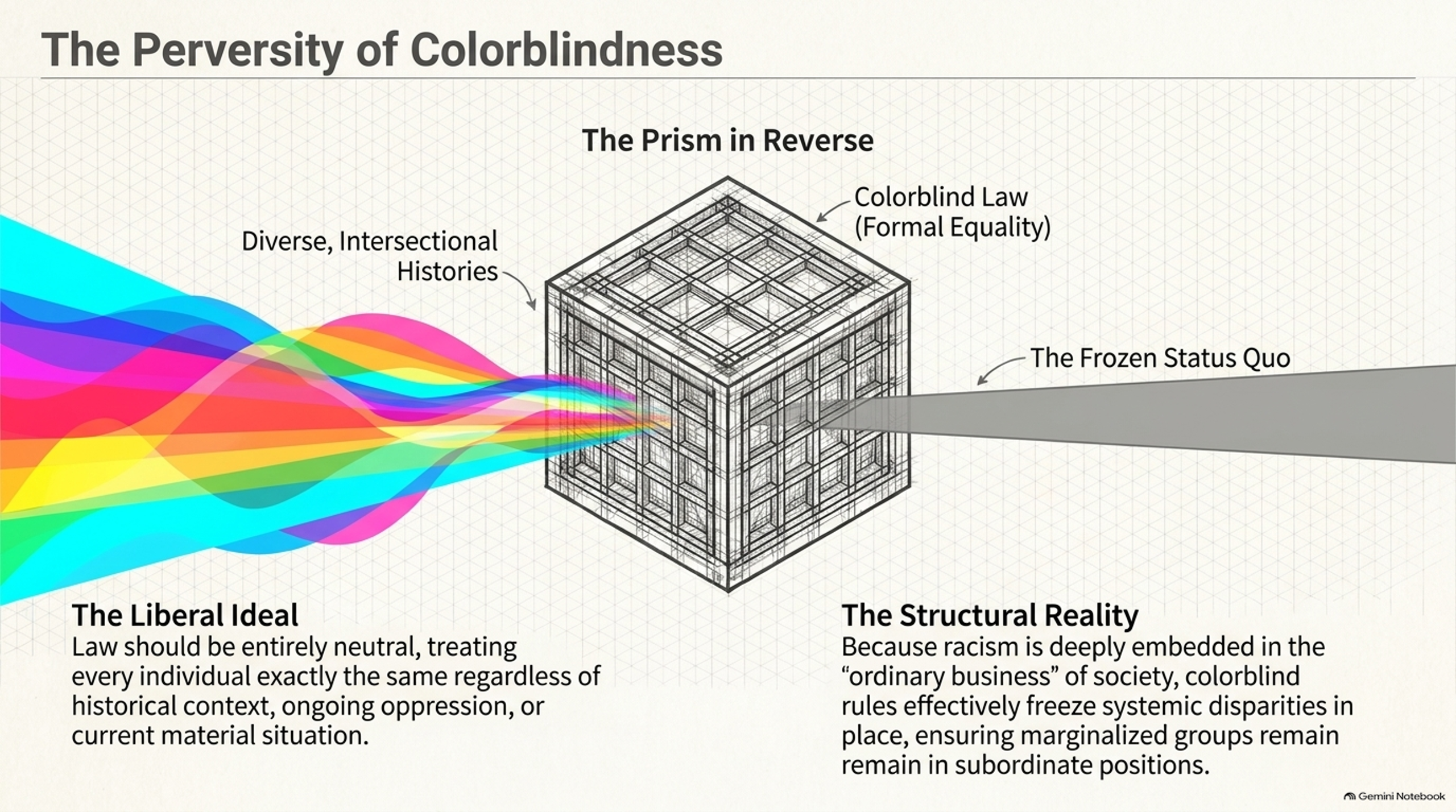
Consequently, traditional "color-blind" or formal equality rules fail to fix systemic inequities. Formal equality only targets extraordinary acts of explicit bias, such as an outright refusal to hire a Black Ph.D. or an immigration dragnet targeting specific Latino workers. It leaves the underlying structural routines intact, ensuring that nonwhite individuals remain in subordinate positions.
결과적으로 전통적인 '인종 맹목적(color-blind)' 규칙이나 형식적 평등주의는 구조적 불평등을 해결하는 데 실패합니다. 형식적 평등은 흑인 박사 학위자의 채용을 명시적으로 거부하거나 특정 라틴계 노동자만을 표적으로 삼는 단속과 같은 명백하고 예외적인 차별 행위만을 바로잡으려 합니다. 이는 밑바닥에 깔린 구조적 일상을 그대로 방치함으로써 유색인종이 계속해서 하위 계층에 머물도록 만듭니다.
To evaluate whether proposed legal reforms actually deliver justice, critical scholar Mari Matsuda urges us to "look to the bottom." Rather than relying on abstract procedural neutrality, we must judge legal rules by whether they relieve the concrete distress of the most disenfranchised groups.
제안된 법적 개혁이 실제로 정의를 실현하는지 평가하기 위해, 비판적 법학자 마리 마츠다(Mari Matsuda)는 우리에게 "밑바닥을 바라보라(look to the bottom)"고 촉구합니다. 추상적이고 절차적인 중립성에 의존하기보다, 가장 권리를 박탈당한 집단의 구체적인 고통을 실제로 완화해 주는지 여부로 법적 규칙을 판단해야 합니다.
"In order to get beyond racism, we must first take account of race. There is no other way." — Justice Harry Blackmun
"인종차별을 넘어서기 위해서는 먼저 인종을 고려해야 한다. 다른 방법은 없다." — 해리 블랙먼(Harry Blackmun) 대법관
Redressing systemic inequality requires abandoning the illusion that ignoring race will eliminate discrimination. Because our baseline social institutions were constructed around racial hierarchies, achieving true equity demands active, race-conscious intervention rather than passive neutrality.
구조적 불평등을 시정하려면 인종을 무시하면 차별이 사라질 것이라는 환상을 버려야 합니다. 우리의 기본 사회 제도가 인종적 계층 구조를 바탕으로 설계되었기 때문에, 진정한 형평성을 달성하려면 수동적인 중립성이 아니라 적극적이고 인종을 인식하는 개입이 필요합니다.
Takeaway 2: Landmark Civil Rights Victories Were Driven by "Interest Convergence," Not Pure Altruism
핵심 인사이트 2: 민권 운동의 승리는 순수한 이타주의가 아닌 '이해관계의 일치'가 이끌었다
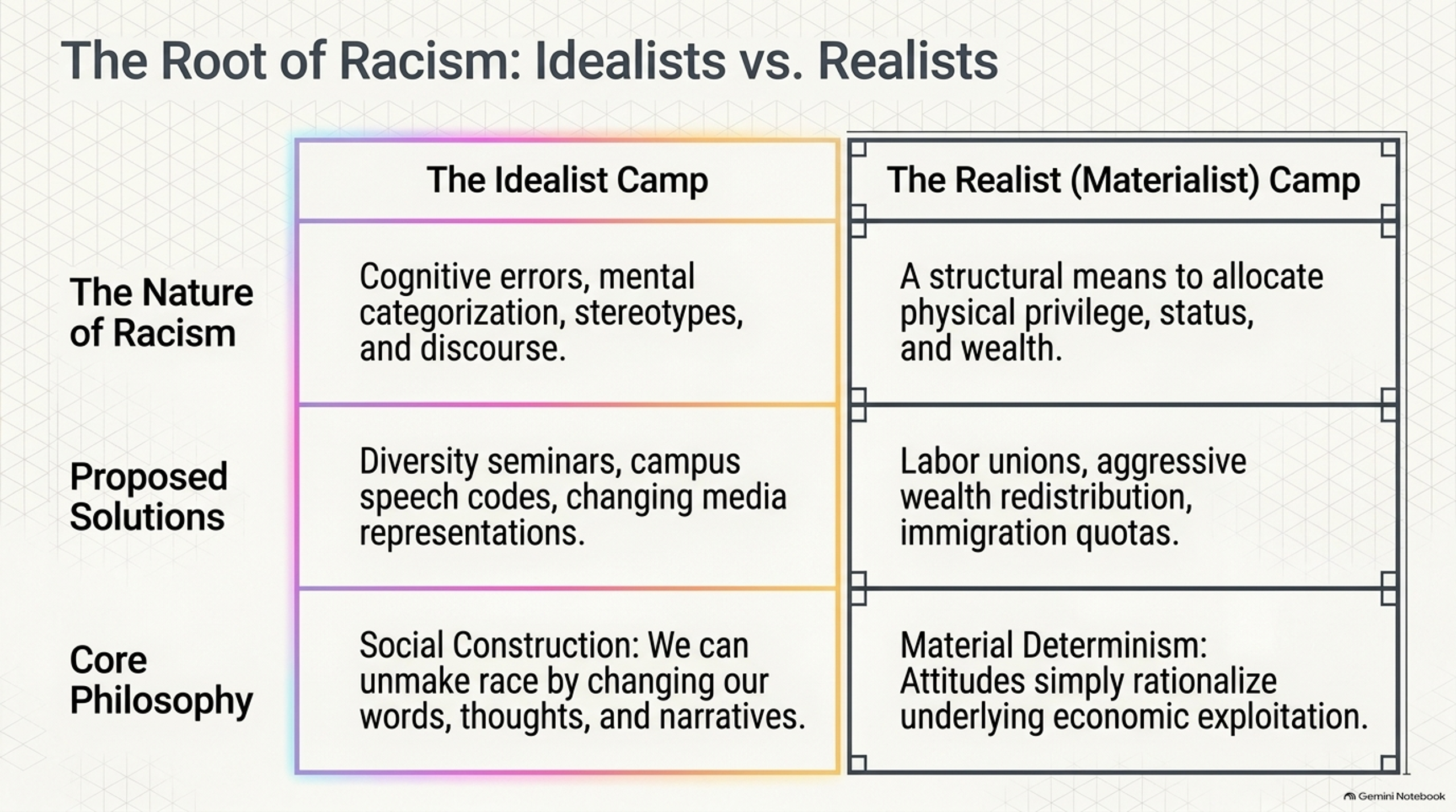
When legal scholar Derrick Bell examined the celebrated triumphs of the civil rights era, he uncovered a sobering structural reality. Under his thesis of interest convergence (or material determinism), major legal breakthroughs for marginalized communities rarely occur through moral suasion or pure altruism alone.
법학자 데릭 벨이 민권 운동 시대의 찬란한 승리들을 분석했을 때, 그는 냉혹한 구조적 현실을 발견했습니다. 그의 '이해관계 일치(interest convergence)' 또는 '물질적 결정론' 이론에 따르면, 소외된 공동체를 위한 중대한 법적 도약은 도덕적 설득이나 순수한 이타주의만으로는 거의 일어나지 않습니다.
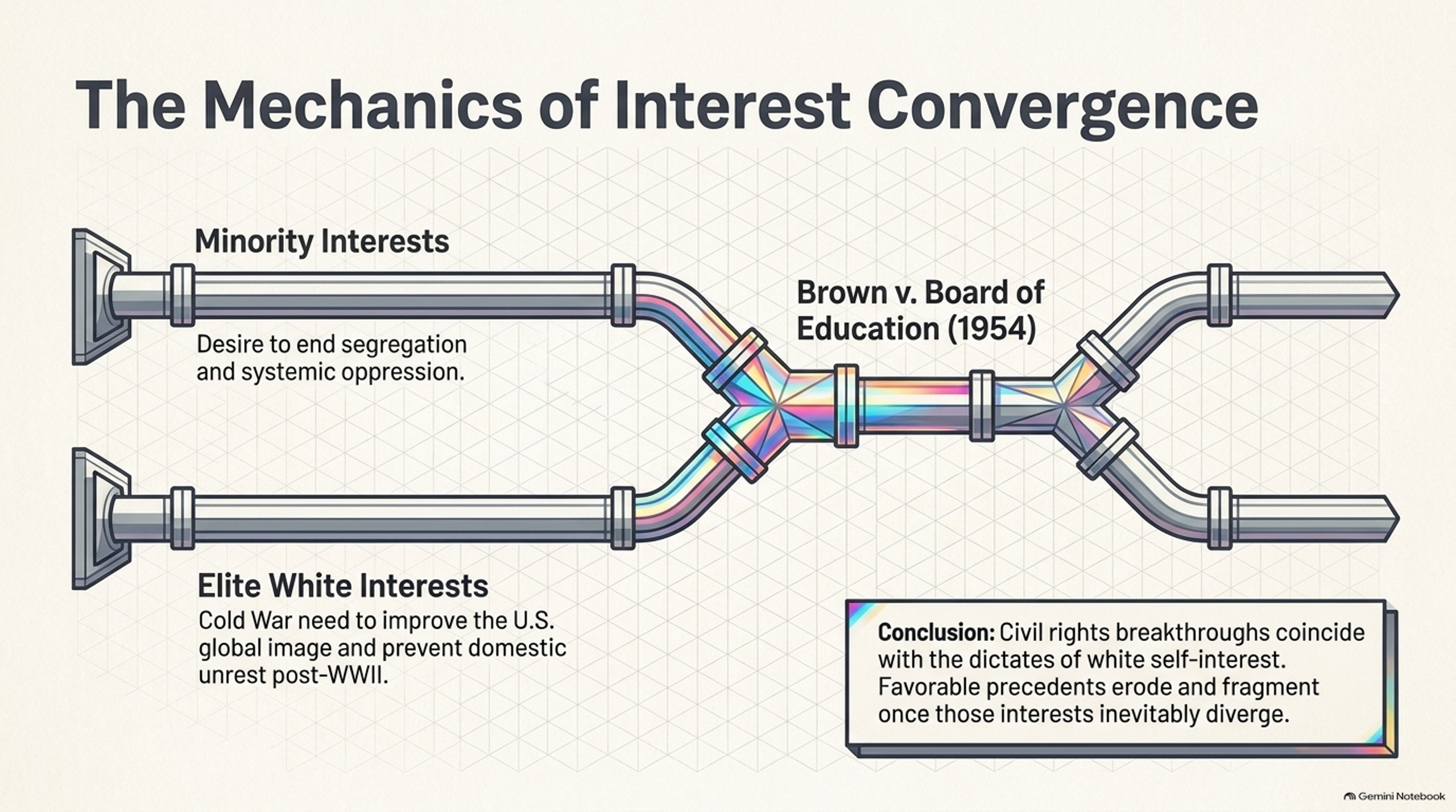
Instead, progress occurs when the demands of oppressed groups happen to coincide with the material self-interest of dominant white elites. Bell illustrated this by reexamining the Supreme Court's landmark 1954 decision in Brown v. Board of Education. For decades, civil rights lawyers had litigated school desegregation cases with minimal success, making the sudden 1954 breakthrough appear unexpected.
대신 진보는 억압받는 집단의 요구가 지배적인 백인 엘리트층의 물질적 자아 이익과 우연히 일치할 때 발생합니다. 벨은 1954년 대법원의 역사적인 '브라운 대 교육위원회(Brown v. Board of Education)' 판결을 다시 분석함으로써 이를 입증했습니다. 수십 년 동안 민권 변호사들은 학교 인종 분리 폐지 소송을 제기했으나 성과는 미미했고, 따라서 1954년의 갑작스러운 돌파구는 뜻밖의 사건처럼 보였습니다.
Bell argued that federal support for desegregation was not a sudden awakening of judicial conscience, but a calculated response to Cold War foreign policy imperatives and domestic unrest. Following World War II and the Korean War, African American veterans returned home unwilling to accept menial labor and social vilification, creating the potential for widespread domestic instability.
벨은 인종 분리 폐지에 대한 연방 정부의 지지가 사법적 양심의 갑작스러운觉醒이 아니라, 냉전 시기의 외교 정책적 필요성과 국내 소요 사태에 대한 계산된 대응이었다고 주장했습니다. 제2차 세계대전과 한국전쟁이 끝난 후 귀향한 흑인 참전용사들은 하드렛일과 사회적 모욕을 더 이상 받아들이려 하지 않았고, 이는 광범위한 국내 불안정을 초래할 잠재력을 지니고 있었습니다.
Simultaneously, the United States was locked in a titanic struggle with international communism for the allegiances of newly independent, nonwhite Third World nations. American leadership recognized that military power alone could not win the Cold War if foreign media constantly broadcast stories of Southern lynchings and brutal racial violence.
동시에 미국은 새로 독립한 비백인 제3세계 국가들의 지지를 얻기 위해 국제 공산주의 세력과 거대한 투쟁을 벌이고 있었습니다. 미국 지도부는 외신들이 미 남부의 린치와 잔혹한 인종 폭력 소식을 지속적으로 보도한다면 군사력만으로는 냉전에서 승리할 수 없음을 깨달았습니다.
Secret State Department and Justice Department cables confirmed that domestic racism was severely harming America's global standing. Federal intervention in Brown was thus directly motivated by a need to improve the nation's international image and secure strategic geopolitical alliances.
국무부와 법무부의 비밀 전보들은 미국 내 인종차별이 미국의 국제적 위상을 심각하게 훼손하고 있음을 확인해 주었습니다. 따라서 브라운 판결에 대한 연방 정부의 개입은 미국의 국격을 높이고 지정학적 동맹을 확보하려는 현실적 필요에서 비롯된 것이었습니다.
"The world respects us not just for our arsenal; it respects us for our diversity, and our openness, and the way we respect every faith." — President Barack Obama, 2016 State of the Union Address
"세상이 우리를 존경하는 것은 단지 우리의 군사력 때문이 아닙니다. 우리의 다원성, 개방성, 그리고 모든 신앙을 존중하는 방식 때문입니다." — 버락 오바마(Barack Obama) 대통령, 2016년 국정연설
Understanding interest convergence transforms how we analyze social reform. It demonstrates that long-term racial progress requires shifting material incentives and structural power dynamics rather than relying solely on appeals to dominant group empathy.
이해관계의 일치를 이해하면 사회 개혁을 분석하는 방식이 완전히 바뀌게 됩니다. 이는 장기적인 인종적 진보를 이루려면 단순히 지배 집단의 공감에 호소하기보다, 물질적 유인 구조와 권력의 구도를 변화시켜야 함을 보여줍니다.
Takeaway 3: Race Has No Biological Basis—It Is Socially Constructed and Continually Repackaged
핵심 인사이트 3: 인종은 생물학적 근거가 없다—사회적으로 구획되고 끊임없이 재포장될 뿐이다
Science confirms that race corresponds to no objective, inherent, or biological reality. Genetic variations across human racial groups are trivial and dwarfed by our shared endowment of traits, leaving physical markers like skin color or hair texture with no connection to higher-order qualities such as intelligence, character, or moral capacity.
과학은 인종이 그 어떤 객관적이거나 고유한 생물학적 실제와도 부합하지 않음을 확인해 줍니다. 인종 집단 간의 유전적 차이는 인류가 공유하는 유전적 특성에 비하면 보잘것없는 수준이며, 피부색이나 머리칼 같은 신체적 표지는 지능, 인격, 도덕적 능력과 같은 고차원적 특성과 아무런 연관이 없습니다.
Instead, society invents, manipulates, and retires racial categories to suit shifting economic and political needs—a dynamic known as differential racialization. Dominant interests actively reshape stereotypes over time to justify labor exploitation or national security agendas.
대신 사회는 변화하는 경제적·정치적 필요에 따라 인종 범주를 창안하고, 조작하며, 폐기합니다. 이를 '차별적 인종화(differential racialization)'라고 합니다. 지배적 기득권은 노동 착취나 국가 안보 명분을 정당화하기 위해 시간에 따라 고정관념을 적극적으로 재구성합니다.
Consider how Middle Eastern populations have been repackaged in the American cultural imagination. In earlier eras, they were depicted as exotic, fetishized figures wearing veils, wielding curved swords, and summoning genies from lamps. Following geopolitical shifts and the events of 9/11, that imagery was swiftly replaced in media and political discourse by the menacing caricature of fanatical, religiously crazed terrorists threatening national security.
중동 출신 인구가 미국 문화적 상상력 속에서 어떻게 재포장되었는지 살펴보십시오. 과거에 그들은 베일을 쓰고 곡도를 휘두르며 램프에서 지니를 불러내는 이국적이고 페티시화된 인물로 묘사되었습니다. 그러나 지정학적 변화와 9/11 테러 이후, 그러한 이미지는 미디어와 정치적 담론 속에서 국가 안보를 위협하는 광신적이고 위험한 테러리스트라는 인상으로 신속하게 대체되었습니다.
- Biological Irrelevance (생물학적 무관성): Genetic variation within racial groups outweighs differences between them, rendering physical traits scientifically meaningless regarding human capability. (인종 집단 내부의 유전적 차이가 집단 간 차이보다 훨씬 크므로, 신체적 특성은 인간의 능력 측면에서 과학적으로 아무런 의미가 없습니다.)
- Economic Manipulation (경제적 조작): Racial categories and stereotypes are actively reshaped over time to justify economic exploitation, such as the historic shifting depictions of Mexican agricultural workers or Japanese populations based on labor demands and war contexts. (멕시코계 농업 노동자나 일본인에 대한 묘사가 노동력 수요와 전쟁 상황에 따라 변화했듯, 인종 범주와 고정관념은 경제적 착취를 정당화하기 위해 적극적으로 재구성됩니다.)
- Differential Racialization (차별적 인종화): Specific groups are designated as threats or resources at different historical moments, demonstrating how cultural scripts adapt to serve dominant societal needs. (특정 집단이 역사적 시점에 따라 '위협' 또는 '자원'으로 다르게 규정되며, 이는 문화적 서사가 사회적 필요에 맞춰 어떻게 변형되는지 보여줍니다.)
Unmasking race as a social construct reveals that racial hierarchies are neither natural nor inevitable. Because these categories were constructed by human institutions to serve specific power dynamics, they can be systematically dismantled through structural critique and legal reform.
인종이 사회적 구성물임을 밝혀내는 것은 인종 계층 구조가 자연스럽거나 불가피한 것이 아님을 보여줍니다. 이러한 범주들은 권력 역동을 섬기기 위해 인간의 제도에 의해 만들어진 것이므로, 구조적 비판과 법적 개혁을 통해 체계적으로 해체될 수 있습니다.
Takeaway 4: The "Empathic Fallacy"—Why Simply Presenting "Better Stories" Doesn't Instantly Cure Bias
핵심 인사이트 4: '공감의 오류'—좋은 이야기를 들려주는 것만으로는 편견이 치료되지 않는다
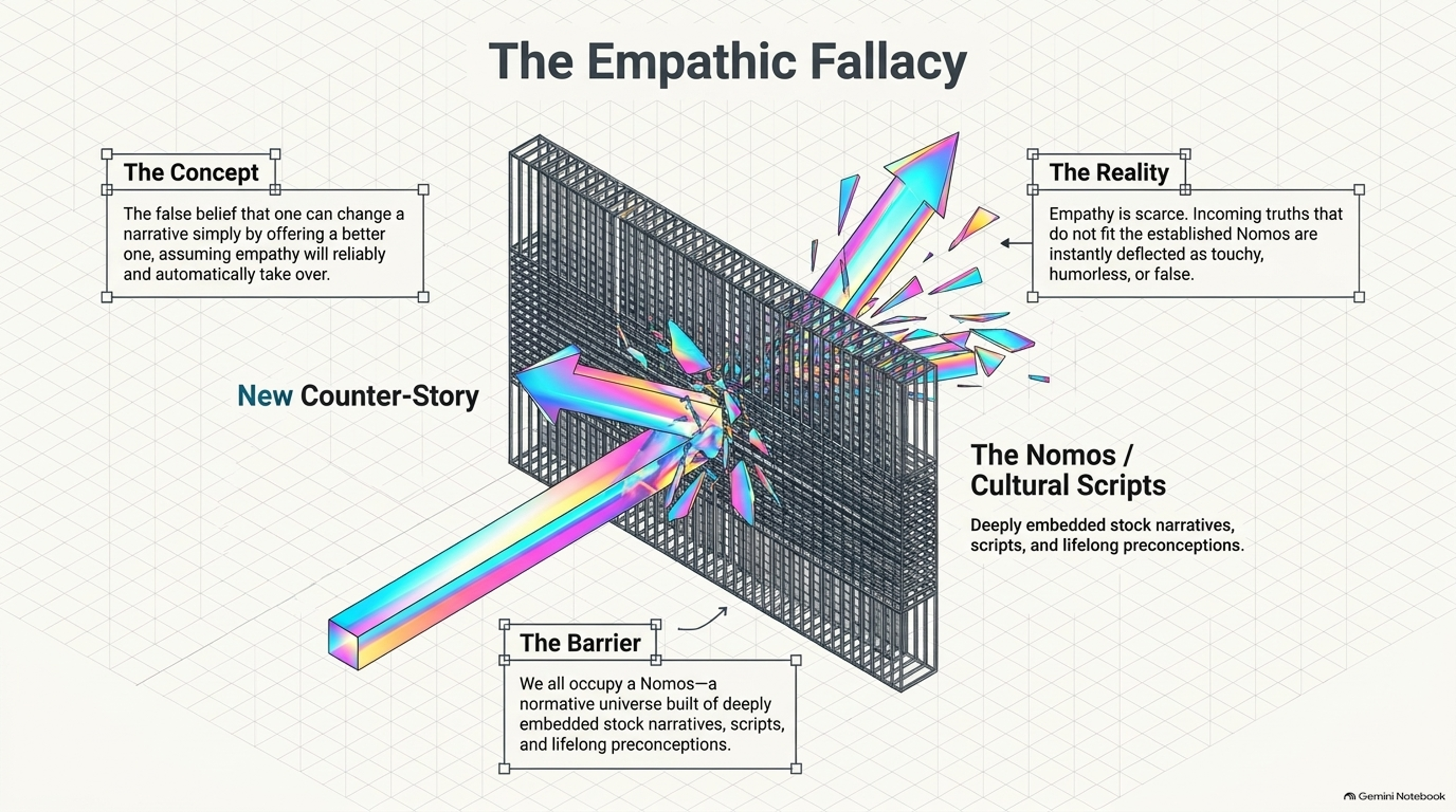
Classical liberal theory frequently advocates a free-market approach to speech, asserting that "the cure for bad speech is more speech." Under this framework, if an individual encounters prejudice or microaggressions, the prescribed solution is to talk back and offer a better, truer narrative, assuming that the listener's empathy will naturally lead to understanding.
전통적 자유주의 이론은 "나쁜 표현에 대한 처방은 더 많은 표현이다"라고 주장하며 표현의 자유에 대한 시장주의적 접근을 옹호하곤 합니다. 이 틀에 따르면 누군가 편견이나 마이크로어그레션을 겪을 때의 해결책은 더 낫고 진실된 서사를 전달하는 것이며, 듣는 이의 공감이 자연스럽게 이해로 이어질 것이라 가정합니다.
Critical Race Theory identifies this assumption as the empathic fallacy—the mistaken belief that one can easily alter deeply ingrained societal narratives simply by presenting a superior story. In reality, individual empathy is a limited resource constrained by structural determinism and shared cultural scripts that dictate how new information is interpreted.
비판적 인종 이론은 이러한 가정을 '공감의 오류(empathic fallacy)'라고 부릅니다. 더 뛰어난 이야기를 제시하는 것만으로 깊이 뿌리박힌 사회적 서사를 쉽게 바꿀 수 있다는 잘못된 믿음입니다. 실제로 개인의 공감 능력은 한계가 있으며, 새로운 정보를 해석하는 방식을 규정하는 구조적 결정론과 문화적 프레임에 의해 제약을 받습니다.
Attempting to "talk back" to entrenched stereotypes or microaggressions is often ineffective and can be physically dangerous, particularly in unbalanced or anonymous settings. Furthermore, challenging embedded cultural scripts frequently leads to the speaker being dismissed as humorless, touchy, or overly sensitive.
고착화된 고정관념이나 차별적 발언에 맞서 대화하려는 시도는 종종 효과가 없으며, 특히 권력 불균형이 심하거나 익명성이 보장된 상황에서는 위험할 수 있습니다. 나아가 기존의 문화적 서사에 문제를 제기하는 사람은 도리어 유머 감각이 없거나 지나치게 예민한 사람으로 치부되기 십상입니다.
These cognitive limits are further entrenched by legal structures. Drawing from Legal Realism and Critical Legal Studies, CRT highlights the concept of legal indeterminacy—the insight that legal rules do not yield single, neutral outcomes, but can be manipulated to support opposing conclusions.
이러한 인식의 한계는 법적 구조에 의해 더욱 고착됩니다. 법실재론과 비판법학에 기반을 둔 CRT는 '법적 불확정성(legal indeterminacy)' 개념을 강조합니다. 즉, 법적 규칙이 하나의 중립적인 결과를 낳는 것이 아니라 상반된 결론을 뒷받침하도록 조작될 수 있다는 통찰입니다.
Traditional legal research tools, indexing categories, and formal legal language act like biological DNA, continually replicating standard ways of thinking while stifling original remedies. As a result, landmark precedent gains like Brown routinely erode over time as lower courts narrowly interpret and restrict their application.
전통적인 법률 검색 도구, 색인 범주, Formal한 법률 용어는 마치 생물학적 DNA처럼 작동하며, 새로운 구제책을 억누른 채 기존의 사고방식을 지속적으로 복제합니다. 그 결과, 브라운 판결과 같은 선례의 성과는 하급 심법원들이 적용 범위를 좁게 해석하고 제한함에 따라 시간이 흐르면서 점차 약화되곤 합니다.
Systemic limits on empathy are further compounded when state institutions break down social support networks. In critiquing excessively long prison sentences, Senior Judge Jack B. Weinstein explained how mass incarceration destroys early family relationships, eroding society's capacity for empathy across generations.
국가 기관이 사회적 지원 네트워크를 해체할 때 공감의 구조적 한계는 더욱 심화됩니다. 잭 B. 와인스타인(Jack B. Weinstein) 판사는 지나치게 긴 형량을 비판하며, 대량 수감이 초기 가족관계를 파괴하고 세대에 걸쳐 사회의 공감 능력을 약화시키는 방식을 설명했습니다.
"[W]ithout regular comforting, physical contact and sensory stimulation from birth, the biological capacity for sociality—the precondition for empathy and conscience—cannot develop . . . and [e]mpathy requires the nurturing required by early social relationships." — Senior Judge Jack B. Weinstein
"출생 직후부터 지속적인 위안, 신체적 접촉, 감각적 자극이 주어지지 않으면 공감과 양심의 전제 조건인 사회성의 생물학적 능력이 발달할 수 없다. 공감은 초기 사회적 관계가 제공하는 보살핌을 필요로 한다." — 잭 B. 와인스타인(Jack B. Weinstein) 선임판사
When state policies systematically break up families through harsh sentencing, they destroy the foundational social conditions required to cultivate human empathy. Real reform requires changing these concrete institutional structures rather than relying on the naive hope that better storytelling alone will cure societal bias.
가혹한 판결을 통해 국가 정책이 체계적으로 가족을 해체할 때, 인간의 공감 능력을 키우는 데 필요한 기초적 사회 환경이 파괴됩니다. 진정한 개혁은 더 나은 이야기 전달만으로 편견을 치료할 수 있다는 순진한 기대에 의존하기보다, 이러한 구체적인 제도적 구조를 바꾸는 것을 요구합니다.
Takeaway 5: "Intersectionality" Explains Why Single-Category Laws Leave People Unprotected
핵심 인사이트 5: '교차성'—단일 범주의 법이 사람들을 보호하지 못하는 이유
Coined by legal scholar Kimberlé Crenshaw, the concepts of intersectionality and antiessentialism challenge the notion that any individual possesses a single, unitary identity. People live at the complex intersections of race, gender, socioeconomic class, and sexual orientation, often experiencing compound forms of discrimination.
법학자 킴벌리 크렌쇼(Kimberlé Crenshaw)가 창안한 '교차성(intersectionality)'과 '본질주의 반대(antiessentialism)' 개념은 개인이 단일한 정체성만을 가진다는 생각을 거부합니다. 사람들은 인종, 성별, 경제적 계급, 성적 지향이 복잡하게 교차하는 지점에서 살아가며, 종종 복합적인 형태의 차별을 경험합니다.
Traditional single-axis legal frameworks routinely fail when applied to these overlapping realities. Consider a Black woman experiencing workplace discrimination who files a lawsuit against her employer.
전통적인 단일 축 법적 프레임워크는 이러한 중첩된 현실을 다룰 때 무력해집니다. 직장 내 차별을 겪고 고용주를 상대로 소송을 제기한 흑인 여성의 사례를 생각해 보십시오.
If she sues for racial discrimination, the employer might successfully defend against the claim by demonstrating that Black men are treated well, played on the company basketball team, and received promotions. If she instead sues for sex discrimination, the employer might defeat the claim by showing that white women face no bias, are routinely hired, and are treated with courtesy.
그녀가 인종차별로 소송을 건다면, 고용주는 흑인 남성들이 좋은 대우를 받고 승진하고 있다는 점을 들어 성공적으로 방어할 수 있습니다. 반대로 그녀가 성차별로 소송을 건다면, 고용주는 백인 여성들이 아무런 편견 없이 채용되고 우대받는다는 점을 보여줌으로써 승소할 수 있습니다.
Under a rigid, single-category legal framework, the plaintiff loses both claims. She is left entirely unprotected because she experiences discrimination specifically as a Black woman—a compound category that single-axis laws fail to recognize.
경직된 단일 범주의 법적 프레임워크 하에서 원고는 두 소송 모두에서 패배합니다. 그녀는 단일 축 법률이 인식하지 못하는 복합적 범주인 '흑인 여성'으로서 차별을 경험했기 때문에 법적 보호의 사각지대에 놓이게 됩니다.
| 차별 유형 | 단일 축 차별 (인종 또는 성별) | 복합적 차별 (인종과 성별의 동시 작용) |
| 집단 경험 | 지배적 하위 집단 중심의 보편화된 경험 | 중첩되고 구별되는 정체성 (예: 유색인종 LGBTQ+, 노동자 계급 유색인 여성) |
| 구제 방식 | 표준화되고 절차적인 법적 구제 | 맥락적이고 개별화된 법적 인정의 필요성 |

Social movements often mirror this legal flaw when they demand that members suppress distinct identities in favor of a "united" front. Forcing individuals into single-category boxes marginalizes "double minorities," requiring both legal institutions and activist movements to embrace contextual, intersectional reality.
사회 운동 역시 단합을 이유로 구성원들에게 개별적 정체성을 억누르라고 요구할 때 이러한 법적 결함을 되풀이하곤 합니다. 개인을 단일 범주에 가두는 것은 '이중 소수자'를 외면하는 결과를 낳으므로, 법적 제도와 운동 단체 모두 맥락적이고 교차적인 현실을 수용해야 합니다.
Takeaway 6: Whiteness Functions as an Unseen, Default Standard of Privilege
핵심 인사이트 6: 백인성은 보이지 않는 기본 특권의 기준으로 작동한다
In Critical White Studies, scholars examine how whiteness is constructed as a transparent, "perspectiveless" baseline. Because white individuals are rarely conditioned to view themselves as having a race, white perspectives are frequently treated as neutral, universal truths ("the way things are"), while nonwhite identities are categorized as exotic or biased deviations from the norm.
비판적 백인 연구(Critical White Studies)에서 학자들은 백인성이 어떻게 투명하고 '관점이 없는(perspectiveless)' 기본값으로 구축되는지 탐구합니다. 백인은 스스로를 인종을 가진 존재로 인식하도록 교육받는 경우가 드물기 때문에, 백인의 관점은 중립적이고 보편적인 진실로 취급되는 반면 유색인종의 정체성은 규범에서 벗어난 이국적이거나 편향된 것으로 규정됩니다.
This false presumption of white neutrality was strikingly illustrated in the federal case Commonwealth v. Local Union 542. In that proceeding, defense attorneys petitioned to disqualify Federal Judge Leon Higginbotham from presiding over a race discrimination suit simply because he was Black.
백인 중립성이라는 이러한 잘못된 전제는 연방 소송 사건인 Commonwealth v. Local Union 542에서 극명하게 드러났습니다. 피고 측 변호인은 판사인 리온 히긴보덤(Leon Higginbotham)이 단지 흑인이라는 이유만으로 인종차별 소송의 재판에서 배제되어야 한다고 신청했습니다.
The defense operated on the unstated assumption that white judges were automatically objective, neutral, and "perspectiveless," whereas a Black judge was inherently biased merely by virtue of recognizing historical racial injustice. Judge Higginbotham issued a powerful opinion rejecting this racial double standard.
피고 측은 백인 판사는 당연히 객관적이고 중립적이며 '관점이 없다'고 전제한 반면, 흑인 판사는 역사적 인종 불평등을 인식하고 있다는 이유만으로 편향되어 있다고 보았습니다. 히긴보덤 판사는 이러한 인종적 이중잣대를 비판하는 판결문을 발표했습니다.
"To suggest that black judges should be so disqualified would be analogous to suggesting that the slave masters were right when . . . they argued that only they, but not the slaves, could evaluate the harshness or justness of the system." — Federal Judge Leon Higginbotham
"흑인 판사가 자격을 박탈당해야 한다고 주장하는 것은, 과거 노예주들이 제도의 가혹함이나 정당성을 평가할 수 있는 것은 노예가 아닌 자신들뿐이라고 주장했던 것이 옳았다고 말하는 것과 같다." — 리온 히긴보덤(Leon Higginbotham) 연방판사
Understanding whiteness requires recognizing the "two-headed hydra" of racial inequality. The first head consists of overt, explicit racism; the second is white privilege—an unearned system of informal favors, courtesies, network connections, and societal benefits extended automatically to members of the dominant group.
백인성을 이해하려면 인종 불평등이라는 '두 머리의 하이드라'를 인식해야 합니다. 첫 번째 머리는 명시적이고 공공연한 인종차별이며, 두 번째 머리는 백인 특권—즉 지배 집단 구성원에게 자동으로 제공되는 비공식적 호의, 예의, 인적 네트워크, 사회적 혜택으로 이루어진 부당한 시스템입니다.
These unearned advantages range from subtle daily assurances—such as store clerks not tracking one's movements—to tangible professional benefits, like extra-credit opportunities, informal networking, and summer jobs extended through personal connections. Dismantling overt racism while leaving structural white privilege intact leaves the underlying racial hierarchy virtually unchanged.
이러한 부당한 이득은 점원이 자신의 동선을 감시하지 않는다는 일상 속 소소한 안도감부터, 인맥을 통한 비공식 기회나 채용 혜택에 이르기까지 다양합니다. 명시적인 인종차별을 해체하더라도 구조적인 백인 특권을 그대로 방치한다면, 밑바닥에 깔린 인종 계층 구조는 거의 바뀌지 않습니다.
Reframing the Future of Race and Law
인종과 법의 미래를 재구성하며
Understanding the intersection of race and the law requires looking beyond surface-level legal declarations and examining the underlying structures that govern social life. Through legal counterstorytelling and narrative analysis, critical scholars illuminate the lived experiences of marginalized groups. These narratives expose how traditional legal categories mask ongoing institutional bias and bridge gaps in public imagination.
인종과 법의 교차점을 이해하려면 표면적인 법적 선언을 넘어 사회적 삶을 지배하는 기저의 구조를 바라보아야 합니다. 법적 대항 서사(counterstorytelling)와 서사 분석을 통해 비판적 학자들은 소외된 집단의 삶의 경험을 조명합니다. 이러한 서사들은 전통적인 법적 범주가 어떻게 제도적 편견을 가리고 있는지 드러냅니다.
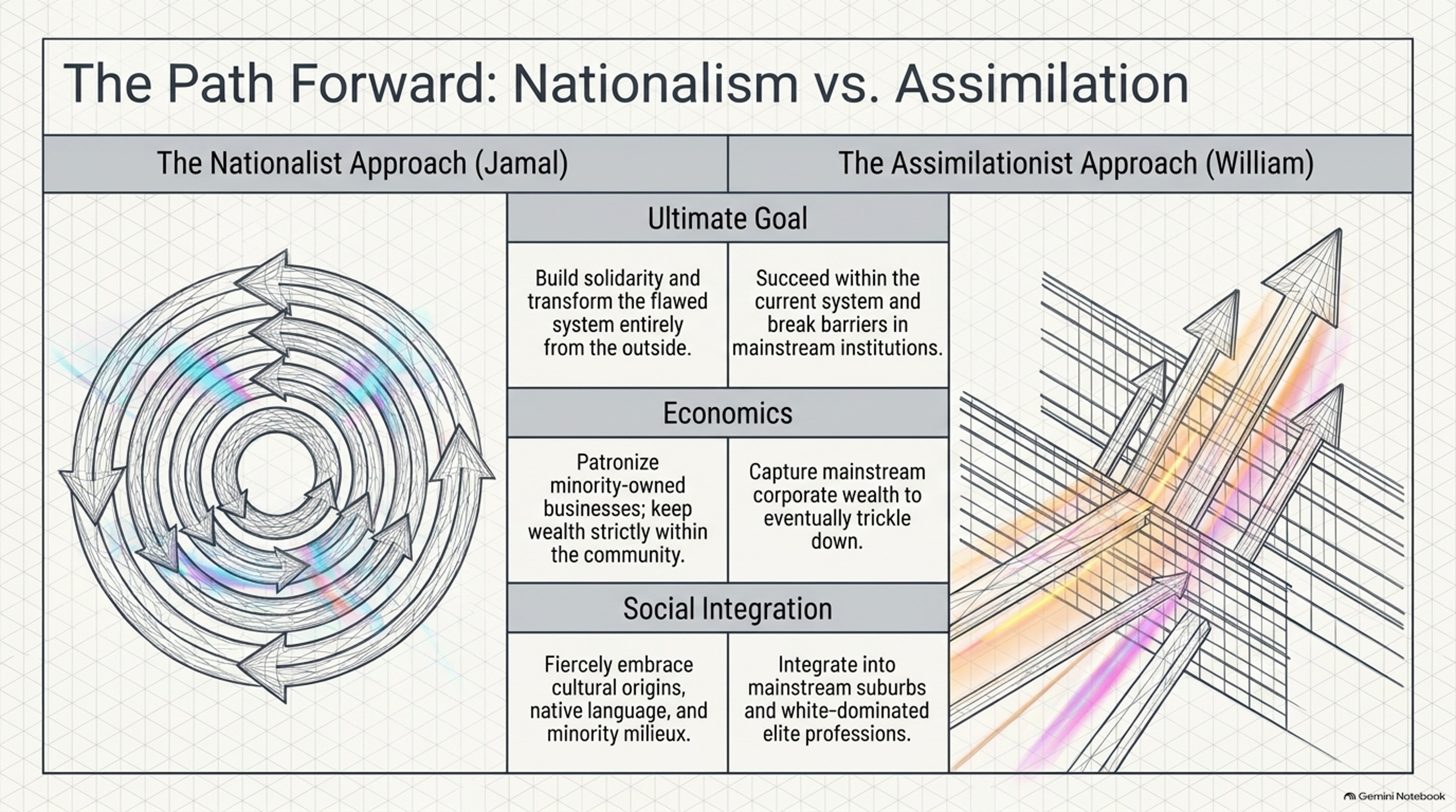
These insights also inform vital internal debates within Critical Race Theory regarding assimilation versus cultural nationalism. While mainstream civil rights advocates seek progress through integration into existing legal and political structures, national-minded scholars like Derrick Bell questioned this strategy. Bell argued that integrating into fundamentally flawed systems was counterproductive, advocating instead for high-quality, minority-controlled institutions, community self-reliance, and educational autonomy.
이러한 통찰은 CRT 내부의 중요한 논쟁, 즉 '동화주의(assimilation)' 대 '문화적 민족주의(cultural nationalism)'에 대한 논의로 이어집니다. 주류 민권 운동가들이 기존 법적·정치적 구조로의 통합을 통해 진보를 도모한 반면, 데릭 벨과 같은 민족주의적 학자들은 이 전략에 의문을 제기했습니다. 벨은 근본적으로 결함이 있는 시스템에 동화되는 것은 역효과를 낳는다고 주장하며, 소수자가 주도하는 양질의 기관 설립, 공동체의 자립, 그리고 교육적 자율성을 옹호했습니다.
This fundamental dialectic reminds us that civil rights progress is neither automatic nor linear. As civic institutions confront evolving questions of policing, immigration, economic inequality, and constitutional interpretation, we cannot remain passive observers of legal doctrine. Are our current systems designed to deliver genuine, structural justice, or do they simply preserve comfortable narratives that leave baseline inequalities intact?
이 근본적인 변증법은 민권의 진보가 자동적이거나 직선적으로 이루어지지 않음을 상기시킵니다. 시민 사회 제도가 치안, 이민, 경제적 불평등, 그리고 헌법 해석이라는 변화하는 문제들에 직면한 지금, 우리는 법 교리의 수동적 관찰자로 남을 수 없습니다. 우리의 현재 시스템은 진정하고 구조적인 정의를 실현하도록 설계되어 있습니까, 아니면 그저 기저의 불평등을 방치한 채 안락한 서사를 보존하고 있을 뿐입니까?